Patents & Protection · September 8, 2026
When Should You Patent an Invention? A Commercialization-First Guide
By Suzi Murphy, InventMentors
Educational content, not legal advice. For questions about your own filing, timing, or disclosure, talk with a registered patent attorney or patent agent.
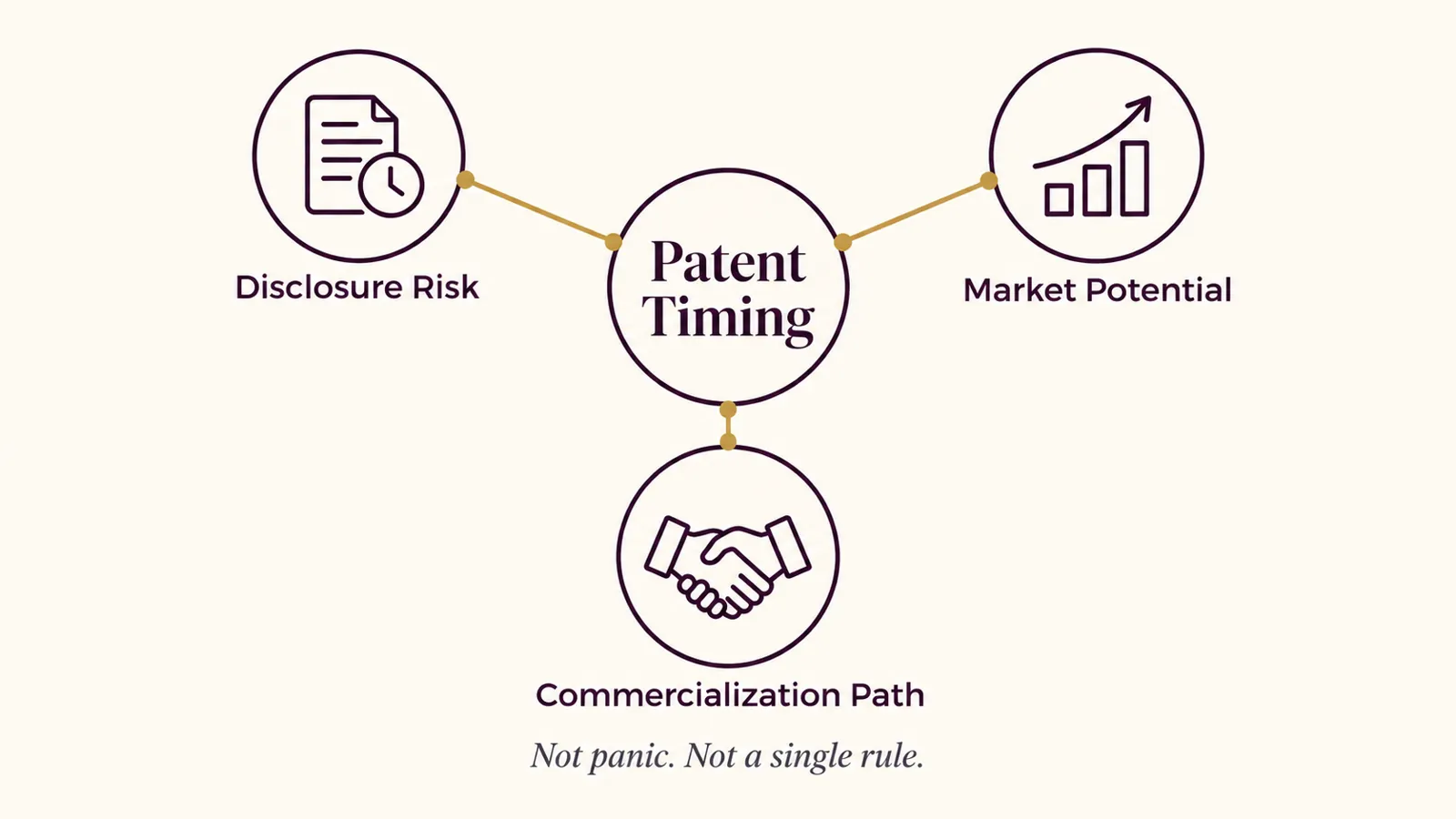
You may need patent guidance before public disclosure or detailed technical sharing, but filing immediately is not automatically the right business move. Patent timing depends on what you have disclosed, what is actually novel, who you are speaking with next, your budget, and whether you plan to license, manufacture, or launch the product yourself.
This article is educational, not legal advice. For filing strategy and disclosure questions, consult a registered patent attorney or patent agent.
Key takeaway: Patent timing depends on disclosure risk and commercialization path, not panic or a one-size-fits-all rule. A patent can support a commercialization plan. It does not replace demand validation, product differentiation, manufacturability, pricing, buyer interest, licensing strategy, or a go-to-market path.
Why a Buyer Reply Can Trigger Patent Panic
A real buyer reply is one of the best signals an inventor can get. It is also, for a lot of first-time inventors, the moment panic sets in: did I already give this away, and should I have filed a patent before I sent anything?
That instinct is common. But panic-filing before you understand what you have shared, what is actually novel, and what commercial path you are pursuing can create unnecessary cost and confusion. A rushed filing built around the wrong feature, or filed without a clear sense of your commercialization plan, does not solve the underlying question: is this invention worth protecting, and what does that protection need to accomplish?
The goal of this article is to walk through how to think about that timing question, without treating a patent filing as either a panic button or an afterthought.
What Can Count as a Disclosure Decision?
Disclosure is one of the more consequential and least understood parts of patent timing for first-time inventors. Actions that can raise disclosure questions include:
● A public product launch
● A crowdfunding campaign
● A trade show display
● Publishing detailed photos or videos
● Selling or offering the product for sale
● A public pitch or presentation
● Posting technical details online
● Sharing detailed drawings, specifications, or prototypes with outside parties
Sharing something outside your own household or company is a disclosure decision. Whether it becomes a legally significant public disclosure depends on what was shown, who received it, whether confidentiality applied, and where you might eventually seek protection. That determination is not something to guess at from a blog post.
Public disclosure, sales activity, confidentiality terms, the details shared, and the countries where protection may be sought can all affect patent options. An inventor should speak with a registered patent attorney or patent agent about their specific facts.
Educational only; not legal advice. Patent rights and disclosure consequences depend on the facts, confidentiality arrangements, timing, and relevant jurisdictions. Consult a registered patent attorney or patent agent about your invention and circumstances.
A Patent Is a Tool, Not a Commercialization Plan
A patent, if granted, can support a licensing pitch, an investment conversation, or a competitive position. It does not, by itself, prove anyone wants to buy the product. It does not prove the product can be made at a price people will pay. It does not prove a company will license it.
That is the gap inventors run into most often. They treat the patent as the finish line. It functions more like one tool among several.
When to Talk With a Patent Attorney or Patent Agent
If you are considering a public launch, crowdfunding campaign, sales offer, detailed technical share, investor presentation, manufacturer conversation, or licensee discussion, a prompt conversation with a registered patent attorney or patent agent can help you understand the risks and options before you move.
This is not a suggestion that every ordinary early-stage conversation requires a lawyer standing by. Plenty of early validation work, described below, can happen without legal review. The point is to get legal guidance when the facts in front of you create meaningful disclosure or filing-timing risk, such as the moments listed above.
Two additional situations worth a prompt conversation:
A potentially valuable technical feature or mechanism. Not every invention has one. If yours does, that feature is often worth discussing with counsel before it shows up in a rendering or spec sheet sent to a wide audience.
International sales, licensing, or patent rights. Rules differ by country, and some countries do not offer the same protections or grace periods as the United States. If your path includes selling or licensing outside the US, this conversation should happen early.
Why a Preliminary Patent Search Matters [NEW SECTION]
Before filing anything, it’s worth understanding what already exists. A patent search, sometimes called a prior art search, looks at existing patents, published patent applications, and other public sources to see whether something similar has already been patented or publicly disclosed.
A search like this can’t tell you with certainty whether your invention will be patentable. Only the USPTO’s own examination can determine that. But it can help in a few practical ways. It can reveal that a feature you thought was novel already exists, before you spend money filing on it. It can sharpen exactly what to describe and claim in a provisional or nonprovisional application. And it can surface competing products worth knowing about for the market-validation side of this decision too, not just the legal side.
Inventors can run an informal search themselves using free tools like the USPTO’s Patent Public Search or Google Patents. That’s a reasonable starting point. A more thorough professional search, generally done by a registered patent attorney, patent agent, or a dedicated search firm, goes deeper and is worth the cost before a nonprovisional filing, when more money and time are on the line.
Educational only; not legal advice. Whether a search is advisable for your situation, and how to interpret its results, depends on your facts. Consult a registered patent attorney or patent agent.
Using AI to Support a Preliminary Search
AI tools can help organize and speed up the informal side of a preliminary search. They can’t replace a professional prior art search, and they can’t tell you whether something is patentable. What they can do is help you generate better search terms, organize what you find, and get ready for a more focused conversation with a patent attorney or search professional.
Prompt 1, generate search terms:
“I’m researching whether an invention like [describe your product and its main function in 2 to 3 sentences] already exists. Give me 10 to 15 alternate search terms, synonyms, and related industry terms I could use to search for existing patents and similar products, including both technical and everyday language.”
Prompt 2, scan for existing products:
“Search for existing consumer products that solve [describe the specific problem your invention solves]. List the products you find, who makes them, and briefly describe how each one works, so I can compare them to my own idea.”
Prompt 3, organize what you find:
“Here are the products and patents I found in my preliminary search: [paste your list]. Organize them into a simple table with columns for name, what it does, and how it’s different from or similar to my invention, which is [describe your invention].”
Prompt 4, prepare for a patent attorney conversation:
“Based on this preliminary research: [paste your findings], help me write a short list of specific questions to bring to a patent attorney about whether my invention might have a novel, protectable feature.”
Educational only; not legal advice. AI tools can help organize research, but they can't determine patentability, and they can miss or misstate results from patent databases. Treat AI-assisted searches as a starting point, not a substitute for a professional patent search or legal advice.
Validate Demand While You Evaluate Patent Timing
Here is the part inventors often get backwards. You do not need to reveal your full technical details to validate demand. You can research the market while you are still working through patent timing, and in most cases, you should.
● Research competing products and price points
● Interview potential users about the problem, not necessarily the specific mechanism
● Estimate market size and customer segment
● Evaluate retail, licensing, OEM, or direct-to-consumer paths
● Assess manufacturing feasibility at a high level
Frustration-based version: an inventor experiences constant worry that a manufacturer or buyer will copy the idea the moment it is shared, and needs a clear way to think about what to protect and when, without paying legal fees for every early conversation.
Desire-based version: an inventor wants to walk into a buyer meeting with confidence instead of dread, and currently settles for guessing whether to file first or talk first.
Coordinate with legal counsel before you get specific about the mechanism itself. The demand-side research does not have to wait on that conversation.
A Rendering Got a Reply. Here Is What One Inventor Did Next.
The following is an example of recurring inventor situations; product details and identifying facts have been changed.
Back in Week 6, an inventor working on a fold-flat pantry door step stool used an AI rendering to show a buyer what a sketch never could. The buyer wrote back within a day. Not a form reply. An actual question: “Does this fold flat enough to hang on the inside of the door?”
That single sentence changed the conversation. This was no longer a hypothetical product. It was a real buyer asking a real follow-up question.
Her first instinct was to search “how to patent an idea” that same night and start a filing before responding to the buyer.
Sending the rendering was a disclosure decision. She needed patent counsel to understand what she had revealed, who had received it, and what options remained. Rather than guess, she called a registered patent attorney to ask exactly that. The rendering’s distribution, who saw it, whether any confidentiality applied, and what her broader plans were all mattered to that answer. A rushed filing that same night would not have resolved those questions, and it would not have answered the buyer’s actual question about the hinge mechanism either.
So she did two things in parallel. She spoke with patent counsel to understand her disclosure position, then kept the buyer conversation moving without volunteering unnecessary technical detail, sharing rough dimensions and price expectations instead of mechanism specifics. That is often a more deliberate next step than panic-filing.
The lesson was not “patent immediately” or “never patent.” It was “get the timing conversation started the same week the buyer conversation gets real.”
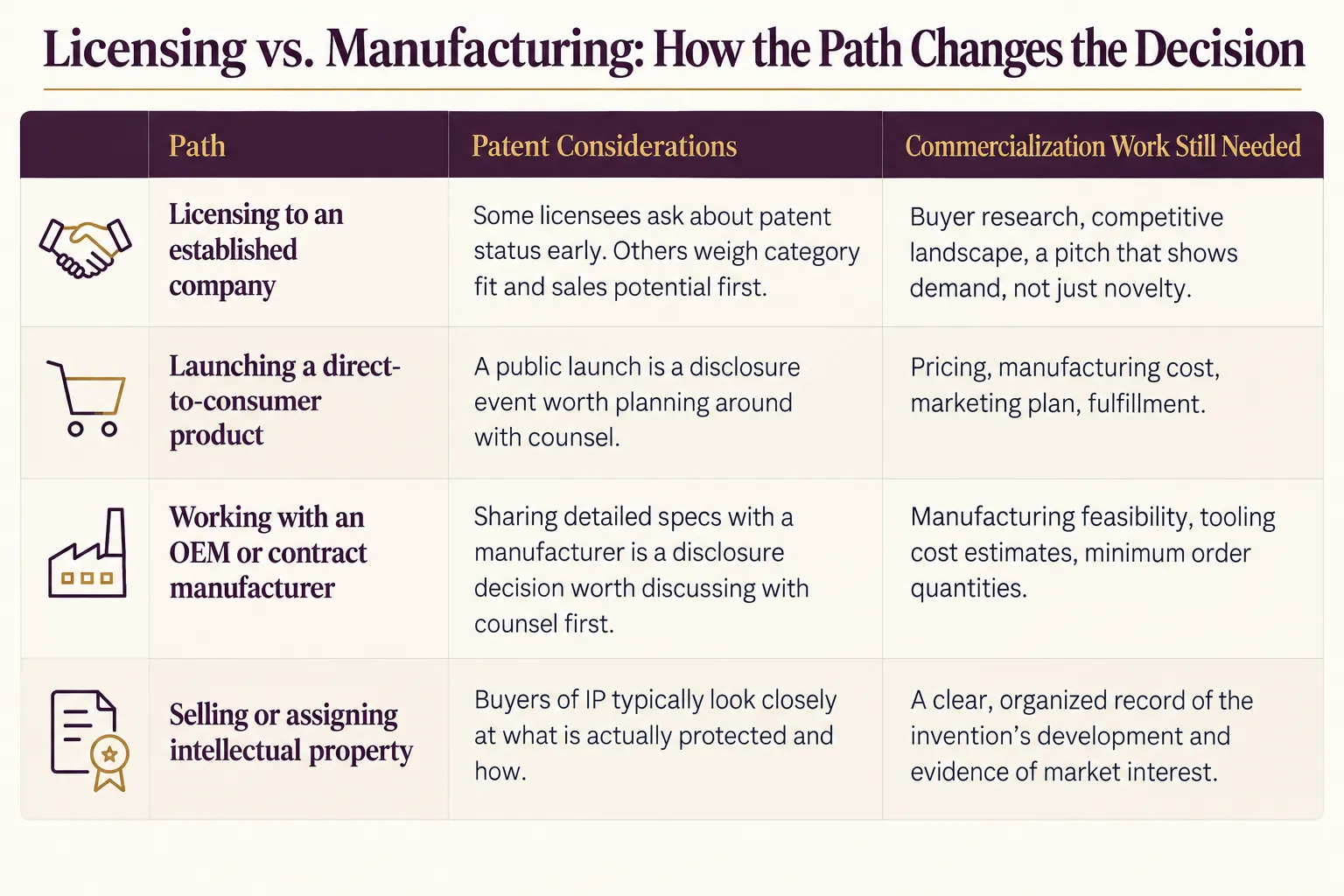
A potential licensee typically weighs more than patent status. Category fit, evidence of customer demand, differentiation from what is already on shelves, margin, retail readiness, and the quality of the presentation all factor in. A patent may strengthen a pitch. It rarely carries the pitch on its own.
Provisional Applications: The 12-Month Window Explained
A U.S. provisional patent application is not a granted patent and is not examined by the USPTO. It can establish an early filing date for the material it adequately describes and gives an inventor up to 12 months to file a corresponding nonprovisional application that claims its benefit.
A provisional application does not automatically make an invention commercially viable, prove market demand, guarantee enforceable claim scope, or resolve disclosure issues that may already have occurred.
A way to think about it: filing a provisional is a little like being first in line at a store, with a specific item already in your cart. Being first in line reserves your spot. If someone shows up after you wanting the same thing, you were there first, and that matters. But standing first in line doesn’t mean the item is yours yet. It means you’ve reserved a chance to complete the purchase, if you come back and finish in time, and if the item turns out to be one the store will actually sell you. Completing the purchase is the nonprovisional application, generally due within 12 months. That’s the filing that actually gets examined, and could eventually become a granted patent. Just like a store can still decline to sell an item, examination can result in narrowed claims, rejections, or no patent at all. Being first in line improves your position. It does not guarantee the outcome.

What Micro Entity Status Is
Micro entity status is a USPTO fee category, not a type of patent. It generally reduces most USPTO fees by a substantial amount compared to the standard rate. To qualify, an inventor typically cannot have been named on more than a small number of previously filed U.S. nonprovisional applications, and gross income generally cannot exceed a multiple of the median household income for the prior year, a figure the USPTO updates periodically. There is also a rule about not having assigned or licensed the invention to a company that exceeds that same income limit.
The exact income threshold and fee amounts change over time, so confirm current figures directly on the USPTO fee schedule rather than relying on a number in an article. Qualifying for the discount and correctly certifying it are two different things, and an incorrect certification can create problems later. Talk to a patent attorney or agent before certifying micro entity status.
What you pay for a provisional application. As a qualifying independent inventor, the provisional filing fee itself is $65 at the micro entity rate, compared with $325 at the standard rate, per the current USPTO fee schedule. That’s the government filing fee only. It doesn’t include costs like a patent attorney or agent drafting the application, professional drawings, a prior art search, or a consultation to help you describe the invention clearly, expenses that are often the larger part of the total cost.
Whether you qualify depends mainly on your income and how many prior applications you’ve filed. A patent attorney or agent can confirm your specific eligibility.
What the 12 Months Actually Gets You
Filing the provisional is the moment you take your place in line. The 12 months that follow is the window to come back and complete the purchase.
During that time, a provisional generally does three things. It establishes a filing date for what is actually described and shown. It allows use of the phrase “patent pending” for up to 12 months. And it is not examined during that period, so no one reviews it for novelty or approves anything.
That window is intentionally unstructured. Inventors often use it to build a prototype, talk with manufacturers, pitch buyers, gather market research, or decide whether the invention is worth pursuing further. It generally costs less than a full nonprovisional filing and buys time without committing to full examination yet.
What “Patent Pending” Tells People, and What It Doesn’t
“Patent pending” communicates one fact: an application is on file. It does not communicate whether that application is a provisional or a nonprovisional, how far along it is, whether it will ever be granted, or what is actually being claimed.
That ambiguity can work in an inventor’s favor. A buyer or a competitor who sees “patent pending” has no way to know if the filing happened yesterday or a year ago, or how strong it is. It can function as a credibility signal without disclosing a legal position.
One caution worth noting: once a provisional lapses without a follow-up nonprovisional, continuing to use “patent pending” can become inaccurate. Talk with a patent attorney or agent about when that phrase should stop being used.
Why This Window Can Support Safer Market Testing
Because the filing date is locked in once the provisional is filed, some of the disclosure anxiety inventors carry can ease during those 12 months. It may be possible to talk with manufacturers, share more detail with buyers, and put the product in front of real people with more confidence about U.S. filing rights.
Two caveats matter here. International rules differ, and some countries do not offer the same protections regardless of a U.S. provisional, so international sales or licensing plans should be discussed with an attorney before sharing broadly. A provisional also only covers what is actually described and shown in it. If the product changes materially during those 12 months, the newer version may not be covered by the original filing.
What Happens at the End of the 12 Months
The 12-month period is a hard deadline with no extensions. Generally, three things can happen.
A nonprovisional application can be filed before the 12 months run out, claiming the benefit of the provisional filing date. This is the path most inventors take if they intend to keep moving forward, the equivalent of coming back to complete the purchase.
The provisional can be allowed to lapse if the inventor has decided not to pursue it further. The claim to that filing date is lost, similar to walking away from the line.
Or a brand new provisional can be filed instead. This does not extend the original filing date and effectively starts a new line.
The stakes are highest for inventors who have disclosed the invention publicly during those 12 months. If the nonprovisional deadline passes without a filing, and the invention has already been shown publicly, sold, or posted online, the ability to protect it at all, not just the earlier filing date, may be lost. This is a firm date to track with a patent attorney or agent, not something to manage from memory.
Educational only; not legal advice. Patent rights and disclosure consequences depend on the facts, confidentiality arrangements, timing, and relevant jurisdictions. Consult a registered patent attorney or patent agent about your invention and circumstances.
The Patent Timing Checklist: 10 Questions to Ask
Have I disclosed this invention publicly, offered it for sale, or posted technical details online?
Am I about to meet with a potential licensee, manufacturer, investor, retailer, or media contact?
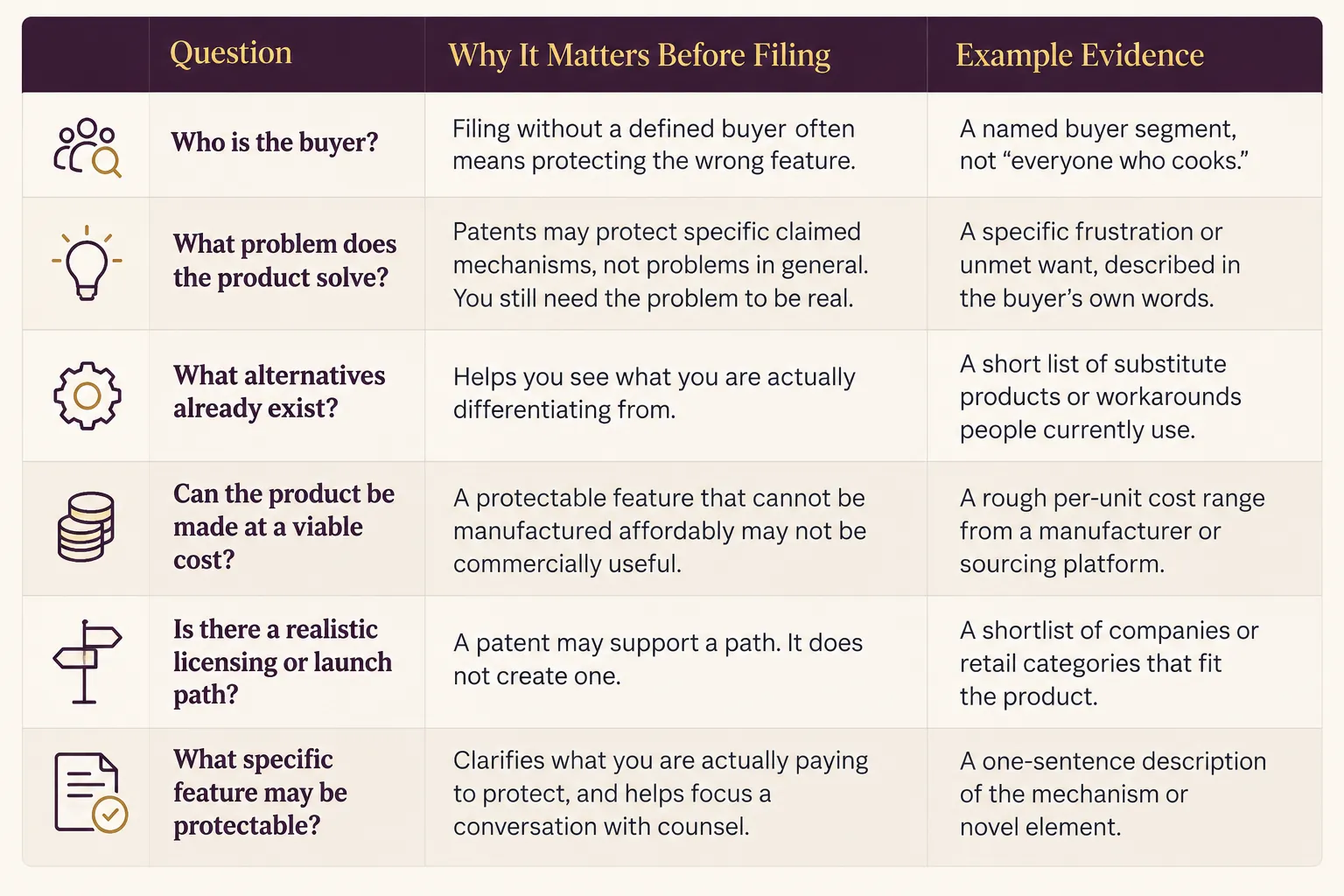
What specific product feature might be novel, and have I described it clearly?
What evidence suggests a real buyer has this problem?
What competing products already address part of the problem?
Does patent protection fit my intended commercialization path: licensing, direct launch, or manufacturing?
Can I fund the stages that come after filing?
Do international markets factor into my plans?
Do I have product drawings, technical descriptions, and test results organized?
Have I had a conversation with a registered patent attorney or patent agent about my specific facts?
The Invent Mentors Commercialization Perspective
Before inventors commit significant resources, they benefit from a coordinated plan that considers market opportunity, customer need, product differentiation, licensing or manufacturing options, and intellectual property strategy together, rather than as separate decisions made in isolation.
Invent Mentors helps inventors prepare market validation research, commercialization roadmaps, target company lists, licensing materials, manufacturer outreach plans, and product positioning work. Registered patent attorneys and patent agents advise on legal filing strategy and disclosure questions. The two should move on the same timeline, in conversation with each other, not as substitutes for one another.
Frequently Asked Questions About Patent Timing
Should I get a patent before talking to a manufacturer?
Not automatically. Sharing detailed specs or prototypes with a manufacturer is a disclosure decision worth discussing with a patent attorney or agent first, but that conversation is about understanding your options, not a rule that a patent must exist before any manufacturer contact.
Can I talk to a buyer before filing a patent?
Often, yes, especially about the problem, price range, and general concept rather than the specific mechanism. Whether a particular conversation creates disclosure risk depends on what is shared, who receives it, and whether confidentiality applies. Speak with counsel about your specific plans.
What counts as public disclosure of an invention?
Actions like a public launch, crowdfunding campaign, trade show display, published photos or videos, a sale or offer for sale, a public pitch, or posted technical details can all raise disclosure questions. Whether a specific action is legally significant depends on the facts.
Do I need a patent to license an invention?
No. Licensees weigh demand, differentiation, manufacturability, and presentation quality alongside any patent status. A patent may strengthen a licensing pitch, but it is not the only factor a company considers.
Does a provisional patent application protect my idea?
A provisional application is not an issued patent and is not examined by the USPTO. It can establish an early filing date for what it adequately describes, but it does not guarantee protection, prove commercial viability, or resolve disclosure issues that may have already occurred.
Can I validate demand before filing a patent?
Yes, in many cases. Market research such as competitor analysis, price comparisons, and problem-focused buyer conversations can often happen without revealing the specific mechanism. Coordinate with counsel before sharing detailed technical information.
What should I do if I already posted my invention online?
Speak with a registered patent attorney or patent agent promptly. Timing and the specific facts of the disclosure matter, and options can narrow the longer the situation goes unaddressed.
What is the difference between a provisional application and a patent?
A provisional application is a filing that can establish an early date and is never examined. A patent is only granted after a nonprovisional application has been examined and approved by the USPTO. They are not the same thing, and a provisional does not become a patent automatically.
What does “patent pending” actually tell people?
It tells them an application is on file, nothing more. It doesn’t reveal whether the filing is a provisional or nonprovisional, how far along it is, or whether it will ever be granted. Once a provisional lapses without a follow-up filing, continuing to use the phrase can become inaccurate, so check with counsel about timing.
What is micro entity status?
It’s a USPTO fee category, not a type of patent, that can significantly reduce filing costs for inventors who meet certain income and prior-filing conditions. The specific thresholds and dollar amounts change over time, so confirm current figures with the USPTO or a patent attorney rather than relying on a fixed number.
How does licensing versus manufacturing affect patent timing?
Licensing conversations often start with demand and category fit, with patent status as one supporting factor. Manufacturing conversations frequently involve sharing detailed specifications, which raises disclosure questions worth discussing with counsel earlier in the process.
When should I call a patent attorney or patent agent?
Before a public launch, crowdfunding campaign, sales offer, detailed technical share, investor presentation, manufacturer conversation, or licensee discussion. These are the moments where the facts most often create meaningful disclosure or filing-timing risk.
Next Steps: Validate Before You Invest
Week 6 covered how an AI rendering can get better buyer feedback before you spend on tooling. This week covered what to do with that reaction, and how to think through patent timing without panic. Next week, Week 8, moves into AI research tools you can use to go deeper on the market itself, once you know what questions you are actually trying to answer.
Patent protection may be an important part of bringing an invention to market, but it works best when it supports a disciplined commercialization plan, not when it replaces one.
Before your next buyer, manufacturer, licensee, or patent-attorney conversation, get clear on the market-side questions: who has the problem, what alternatives exist, what buyers respond to, and which commercialization path fits. Start with an Invent Mentors validation conversation.
Educational only, not legal advice. Patent timing and disclosure questions depend on your facts and jurisdiction.
Sources and Further Reading
● USPTO, Provisional Application for Patent
● USPTO, Patent Basics
● USPTO, Finding a Registered Patent Attorney or Agent
Invent Mentors helps inventors with market validation and commercialization strategy, not legal advice. For patent questions, consult a registered patent attorney or patent agent.
Connect: LinkedIn · Start a validation conversation
Related reading
Ready for a structured score?
Take the free Validation Assessment. 15 questions, 5 minutes, instant clarity.
Get Your Validation Assessment (Free)