Patents & Protection · September 14, 2026
Before You Fall in Love With Your Idea: AI Tools for Checking If It's Already Been Invented
By Suzi Murphy, InventMentors
Educational content, not legal advice. For questions about your own filing, timing, or disclosure, talk with a registered patent attorney or patent agent.
“I’ve never seen anything like this anywhere” is one of the most expensive sentences in product development. It feels like proof. It is usually just a sign that you have not looked hard enough yet. A prior art search, done well, tells you what already exists before you spend another dollar on tooling, branding, or a provisional filing.
Last week covered when to file a provisional patent application. This week covers the step that should happen before that decision gets made at all: checking whether your invention, or something close to it, is already out there. This is where AI-powered search tools genuinely help, and where they get misunderstood.
Why Does a Prior Art Search Matter More Than a Feeling of Originality?
A prior art search matters because patentability is a legal determination, not a personal impression. Prior art includes issued patents, published patent applications, existing products, articles, and anything else publicly disclosed before your invention. An AI prior art search helps you scan that landscape quickly, before you invest in prototypes, tooling, or a patent filing.
I met with an inventor. This is a fictionalized composite based on recurring inventor situations, with product and identifying details changed. She spent four months and several thousand dollars on a prototype and a provisional filing for a kitchen tool, convinced no one had built anything similar. A basic search using an AI-powered patent tool turned up two nearly identical products already on the market, one of them sold at a major retailer. The invention was not worthless. It just was not new in the way the inventor believed. The lesson was not “stop inventing.” It was “search first, spend second.”
Frustration-based version: an inventor experiences constant doubt about whether an idea is truly original, and needs a fast, reliable way to check before spending on tooling or a filing, without paying for a full professional search on every early idea.
Desire-based version: an inventor wants to walk into a buyer or investor conversation with confidence, and currently settles for hoping no one points out something that already exists.
Can AI Tell Me If My Idea Is Patentable?
No. This is the single most common mistake inventors make with AI right now. General AI chat tools like ChatGPT or Claude can describe similar products and summarize technical concepts, but they are not connected to live patent databases, and they can miss relevant prior art or state things with confidence that turn out to be wrong. No AI tool, search platform, or attorney can guarantee that an invention is patentable. In the United States, the USPTO makes the official patentability determination during examination of a filed application, subject to review and appeal processes. What AI can help with is the informal, early-stage research that gets you ready for that process, not a replacement for it.
Which AI-Powered Search Tools Are Actually Built for This?
Two free, publicly available options are worth knowing:
● Google Patents covers a large body of US and international patents and published applications, with full-text search and citation lookup. It is a solid starting point for keyword and citation-based searching.
● The USPTO’s Patent Public Search tool is the free, official database of US patents and published applications. It includes an AI-assisted feature called Inventor Search Assistant, built specifically to help independent inventors search without needing complex query syntax, and it surfaces non-patent literature and foreign patent documents alongside patents, which makes it a stronger starting point than a general keyword search if you are not sure what search terms to use yet.
Neither replaces a professional search or an attorney’s judgment. Both are meaningfully better first steps than typing a question into a general AI chatbot and treating the answer as fact.
How Do You Actually Use AI to Support This Search?
These four prompts are different from anything in a prior InventMentors piece. Use them in order.
Prompt 1, turn your idea into a search-ready description: “Rewrite this description of my invention into a clear, technical, search-ready description I could enter into a patent search tool like Google Patents or the USPTO’s Patent Public Search: [describe your invention in plain language, 2 to 3 sentences].”
Prompt 2, search beyond patents: “Beyond patents, what other public sources might describe something similar to [describe your invention], such as trade publications, industry articles, crowdfunding campaigns, or academic papers? List the types of sources I should check and example search terms for each.”
Prompt 3, compare your invention to close results: “Here are 3 to 5 patents or products I found that seem close to my invention: [paste short descriptions]. For each one, identify what is similar and what is different from my invention, which is [describe your invention].”
Prompt 4, decide if you need a professional search: “Based on how close these results are to my invention: [paste your comparison from Prompt 3], help me think through whether this looks close enough to warrant a professional prior art search or a conversation with a patent attorney, and what specific differences I should ask them to evaluate.”
Key Takeaways
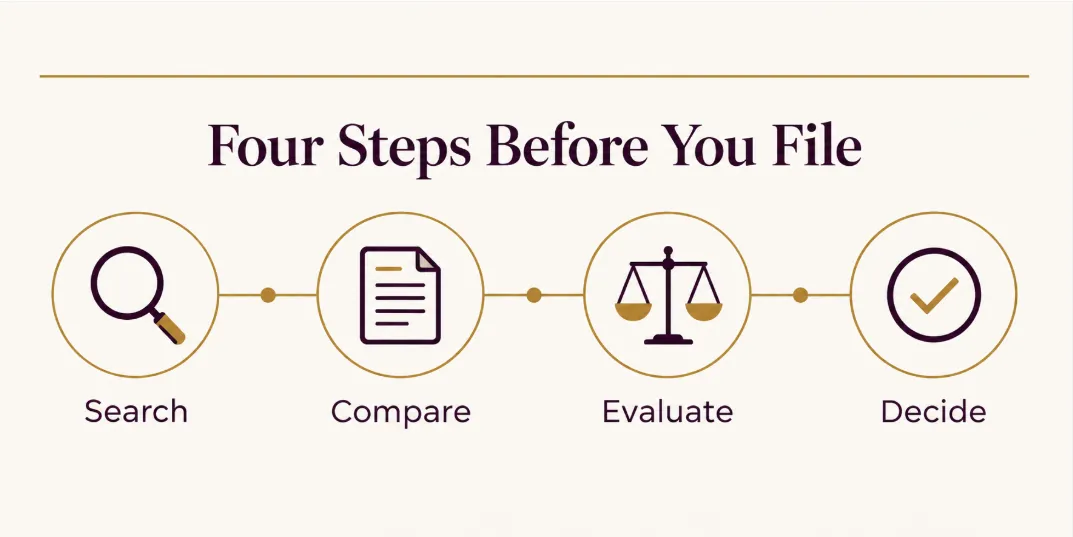
● Last week covered patent timing and provisional applications. This week covers the search that should happen before that filing decision, not after it.
● Prior art is broader than patents. It includes existing products, articles, and anything publicly disclosed before your invention.
● General AI chat tools cannot determine patentability and are not built on live patent databases.
● Free AI-powered tools like Google Patents and the USPTO’s Patent Public Search are legitimate first steps for an AI prior art search.
● Close results are not a dead end. They are the signal to bring specifics to a patent attorney.
Frequently Asked Questions
Can AI tell me if my idea is patentable? No. AI tools can help you search and organize what you find, but no AI tool, search platform, or attorney can guarantee patentability. The USPTO makes the official determination during examination of a filed application.
What is the difference between a patent search and a full prior art search? A patent search looks only at patents and published applications. A full prior art search also includes existing products, trade publications, academic papers, and anything else publicly disclosed before your invention.
Are free tools like Google Patents or the USPTO’s Patent Public Search good enough for a first pass? For an early, informal check, yes. They are not a substitute for a professional search or an attorney’s evaluation once you have found something close.
What happens if I skip this and find out later something already exists? It can cost you money already spent on tooling, branding, or filing fees, and it can affect your patent strategy. Checking early is far cheaper than finding out after you have invested.
Next Steps
Week 7 covered when to talk with a patent attorney and how provisional applications work. This week covered what to check before that conversation even happens. Next week, we come back to a different question entirely: knowing your invention is new answers a legal question, not a business one. Week 9 returns to the Validation Assessment to help you check whether anyone actually wants it.
If you have not run your idea through it yet, start here: inventmentors.com/validation
Validate before you invest.
Educational only, not legal advice. Every fact above depends on your specific invention and situation. Talk with a registered patent attorney or patent agent before making a filing decision.
Related reading
Ready for a structured score?
Take the free Validation Assessment. 15 questions, 5 minutes, instant clarity.
Get Your Validation Assessment (Free)