AI for Inventors · November 9, 2026
I Have an Invention Idea. Where Do I Start?
By Suzi Murphy, InventMentors

You have an idea. It keeps you up at night.
You search “what to do with an invention idea” and get a wall of ads. Patent services. Prototype shops. Companies promising to take your idea to market.
Everyone wants to sell you the next step. Nobody tells you which step comes first.
That order matters more than the idea. Spend in the wrong order and you lose money, time, and sometimes your patent rights.
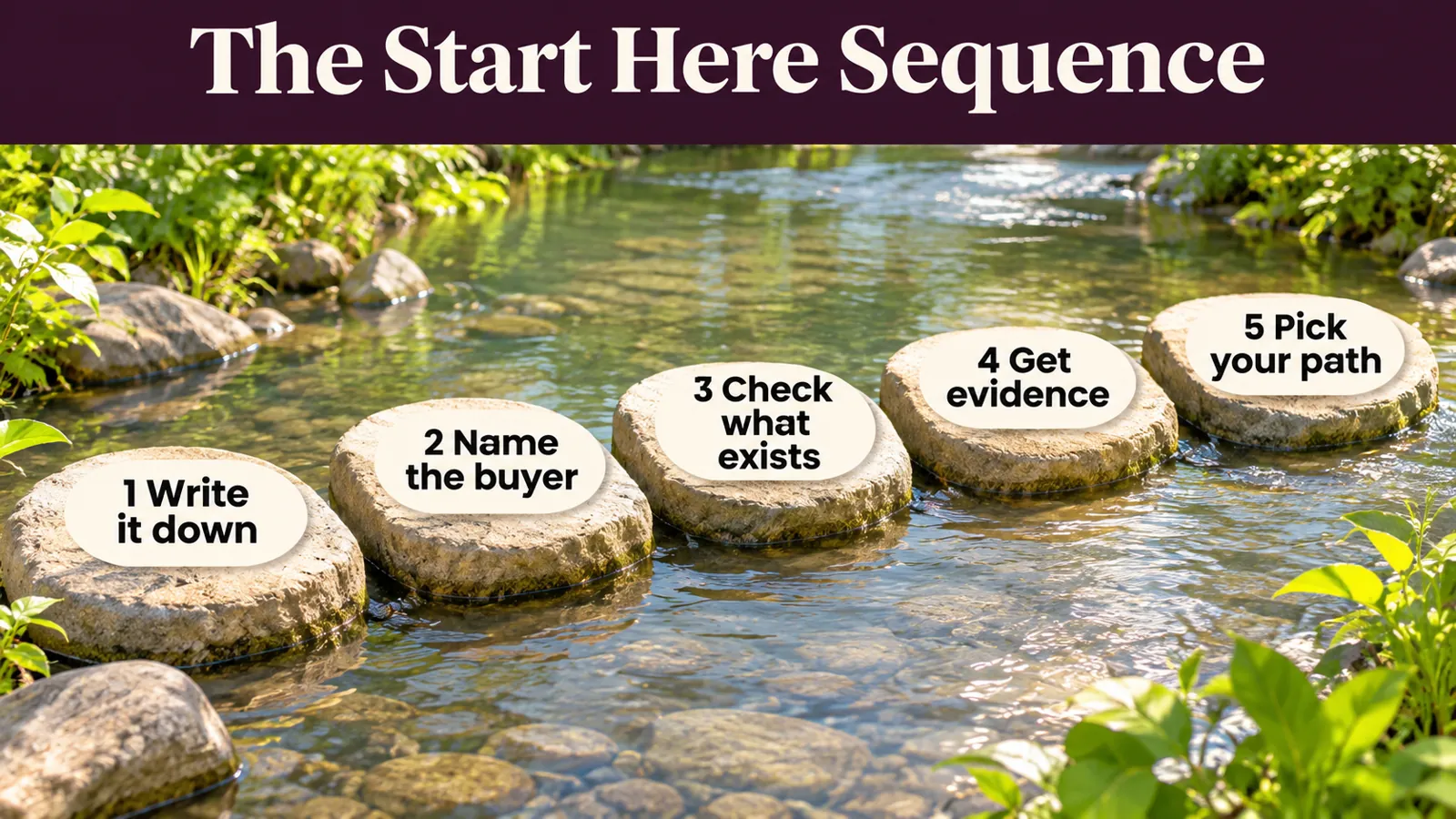
This article gives you the order. I call it the Start Here Sequence.
Where do you start with an invention idea?
Start by writing your idea down, dating it, and keeping it private. Then name the exact buyer and their pain. Check whether it already exists. Collect real buyer evidence. Only then choose a path, license or make, and decide what to spend on. Patents, tooling, and paid promoters come after evidence, not before.
Most first-time inventors start with the most expensive step. They call a patent firm or a company from a late-night ad.
Those calls feel like progress. They are often a detour.
Why is the first step so confusing?
The first step is confusing because most free advice comes from people selling a service. A patent firm points you to patents. A prototype shop points you to prototypes. A promotion company points you to its package.
None of them start with the question you need answered first: will anyone buy this?
On inventor forums, the same question repeats. “I have an idea. Where do I start?” Then comes the worry. “I want to patent it so nobody steals it, but I don’t know if it’s worth it.”
That worry is normal. It is also where the expensive wrong turn begins.
What does a $30,000 wrong turn look like?
I have watched inventors spend up to $30,000 on molds before a single buyer said yes.
The mold arrives. The first parts come off the line. It feels like the finish line.
Then the boxes sit in the garage.
Nobody asked the buyer the Cost Question. What would you give up to have this today? Money? Time? A spot on a waitlist?
When inventors finally ask, the answers often change the product. A different size. A different price. Sometimes a different buyer entirely.
But by then, the mold is already cut.
The idea was not bad. The order was.
One week of buyer conversations costs almost nothing. A mold built for the wrong buyer can cost $30,000.
That is the lesson. The first dollar should buy evidence, not protection or production.
What is the Start Here Sequence?
The Start Here Sequence is a five-step order for any new invention idea. Each step answers one question before you spend on the next. It moves you from a private idea to a clear decision, license or make, with evidence in hand. Most steps cost time, not money, and AI makes each one faster.
Step 1: Write it down. Date it. Keep it private.
Describe what it does, who it is for, and how it works. Add sketches. Sign and date each page.
Do not post it, sell it, or pitch it publicly yet. Public disclosure starts patent clocks. In the US there is a one-year grace period after your own disclosure, but many other countries do not offer one.
Talk with a registered patent attorney or agent about your situation before you go public. Rules depend on your facts.
Step 2: Name your buyer and their pain.
“Everyone” is not a buyer. Pick one person you could find and call this week.
Use the statement that fits your invention.
Frustration-based, for problem-solving inventions:
[Buyer] experiences [frustration] when [situation]. They need [outcome] without [current workaround].
Desire-based, for novelty or delight inventions:
[Buyer] wants [feeling or experience]. They currently settle for [lesser alternative].
Week 3 shows you how to [name your real buyer].
Step 3: Check if it already exists.
Search store shelves, Amazon, and Google Shopping. Then search Google Patents and the USPTO Patent Public Search tool.
Finding something close is not failure. It is data. It tells you what to beat and what buyers already pay.
Week 8 walks through AI prior art search step by step.
Step 4: Get buyer evidence, not compliments.
“I’d buy that” means nothing. Ask what your buyer would give up instead.
Week 4 shows you how to [ask buyers the Cost Question]. Ask about money, time, or a spot on a waitlist.
A deposit, a pre-order, or a signed letter of interest beats one hundred likes.
Step 5: Pick your path. License it or make it.
Licensing means a company makes and sells it. You earn a royalty.
Manufacturing means you run the business. You carry inventory, cash, and risk.
Last week, you learned to [choose with the License-or-Make Filter]. Your path decides what you spend on next.
How can AI help you start?
AI for inventors turns weeks of searching into an afternoon. Use it to organize your idea, run market demand checks, and prepare buyer questions. AI does not replace buyer conversations or legal advice. Treat every answer as a lead to verify, not a final verdict.
Run these prompts in order.
Prompt 1: Organize the idea
I have an invention idea. Here is my rough description: [describe it]. Turn this into a one-page invention summary with: the problem it solves, who has the problem, how it works, what makes it different, and the three biggest unknowns I should test first. Ask me questions about anything unclear before you write it.
Prompt 2: Find the buyer
Based on this invention summary: [paste]. List five specific buyer types who feel this problem most. For each, describe where they shop, what they use today, and what they pay for it. Then write one frustration-based or desire-based buyer pain statement for the strongest buyer.
Prompt 3: Scan what exists
List products currently sold that solve the same problem as this invention: [paste summary]. Include product names, typical price ranges, and where they are sold. Then list search terms I should use on Google Patents and the USPTO Patent Public Search tool. Mark anything you are unsure about so I can verify it.
Prompt 4: Prepare the Cost Question
I want to talk to [buyer type] about [problem]. Write eight interview questions that ask about past behavior and what they would give up, not opinions. Avoid any question that invites a polite yes. Include one question that asks for a small commitment, like a deposit or waitlist signup.
Prompt 5: Pressure-test the path
Here is my invention summary and what buyers told me: [paste]. Compare licensing versus manufacturing for this idea. Cover upfront cost, time to revenue, control, and risk. Tell me which three facts I still need before I decide.
What should you not spend on first?
Hold off on these until you have buyer evidence:
● A utility patent application before you know the market
● Injection mold tooling or large inventory orders
● Paid invention promotion or submission packages
● A logo, website, or LLC before anyone has said yes
A patent protects an idea. A mold produces it. Neither one proves anyone wants it. Evidence first, then spending that fits your path.
Key takeaways
● The Start Here Sequence gives you the right order: write it down, name the buyer, check what exists, get evidence, pick your path.
● The expensive wrong turn is paying for protection or production before you have buyer evidence. A mold alone can cost up to $30,000.
● AI for inventors speeds up every step, from organizing your idea to market demand checks.
● Last week, the License-or-Make Filter helped you choose a path. This week shows where that choice sits in the bigger sequence.
● Validate new product ideas with buyer commitments, not compliments.
FAQ
What is the Start Here Sequence?
The Start Here Sequence is a five-step order for new invention ideas, created by Suzi Murphy of InventMentors. The steps are: write it down and keep it private, name your buyer, check what exists, get buyer evidence, and pick your path. It helps inventors avoid spending before they know anyone will buy.
Should I patent my invention idea first?
Usually not as the very first step. Most inventors benefit from checking the market and talking to buyers before paying for a utility patent. Keep the idea private and talk to a registered patent attorney or agent about timing for your situation.
How much does it cost to start an invention?
The first four steps of the Start Here Sequence cost mostly time. Costs rise with prototypes, patents, and tooling. Molds alone can run up to $30,000, which is why buyer evidence should come first.
Should I use an invention promotion company?
Be careful. Many charge large upfront fees whether or not your product ever sells. Before signing, ask in writing how many clients earned more than they paid.
Can AI tell me if my invention will sell?
No. AI helps you organize, research, and prepare. Only buyers can tell you if it will sell, through deposits, pre-orders, or commitments.
Next steps
● Missed Week 3? Start there to [name your real buyer].
● Ready to talk to buyers? Learn to [ask buyers the Cost Question] in Week 4.
● Checking what exists? Follow the AI prior art search steps in Week 8.
● Choosing a path? Go back and [choose with the License-or-Make Filter] from Week 13.
● Want a fast read on where your idea stands? Take the free Validation Assessment at https://www.inventmentors.com/validation. Fifteen questions, about five minutes.
Next week: What a manufacturer needs from you before they quote.
Your idea deserves the right order. Start here.
Suzi Murphy is the founder of InventMentors, a market validation and licensing strategy firm for inventors, founders, and patent attorneys. She has taken a product through the full licensing process to a signed agreement with a brand manufacturer.
InventMentors provides commercialization and validation guidance. It does not provide legal advice or patent filing services. Talk with a registered patent attorney or agent about your specific situation.
Related reading
Ready for a structured score?
Take the free Validation Assessment. 15 questions, 5 minutes, instant clarity.
Get Your Validation Assessment (Free)