AI for Inventors · November 2, 2026
Your AI Validation Partner: How Inventors Use AI to Save Time and Money Before They Invest
By Suzi Murphy, InventMentors
Most inventors don’t lose money on bad ideas.
They lose it on unchecked ones.
A friend says “I’d buy that.” A quick search finds nothing. The idea feels new. So the spending starts: patent fees, prototypes, tooling, packaging.
Then the hard questions show up after the money is gone.
Last week covered using AI to research licensing companies and manufacturers. This week puts every step of the series into one framework you run before you pitch or spend. It’s called The AI Validation Partner.
What Got Me a Signed Licensing Agreement?
Evidence got me a signed licensing agreement. When I sat down with a brand manufacturer, I wasn’t asking them to believe in me. I was showing them what I already knew: who the buyer was, what buyers disliked about existing options, and what was already on the market.
That changed the conversation.
Companies don’t sign hunches. They sign ideas that look like less risk.
Getting to that point took me a lot of time.
Today, much of that homework takes hours with AI. It can sort buyer complaints, scan what already exists, and shortlist the companies that fit.
It doesn’t make the decision. You do.
But it gets you to the evidence faster, and before you spend real money.
What Is The AI Validation Partner Framework?
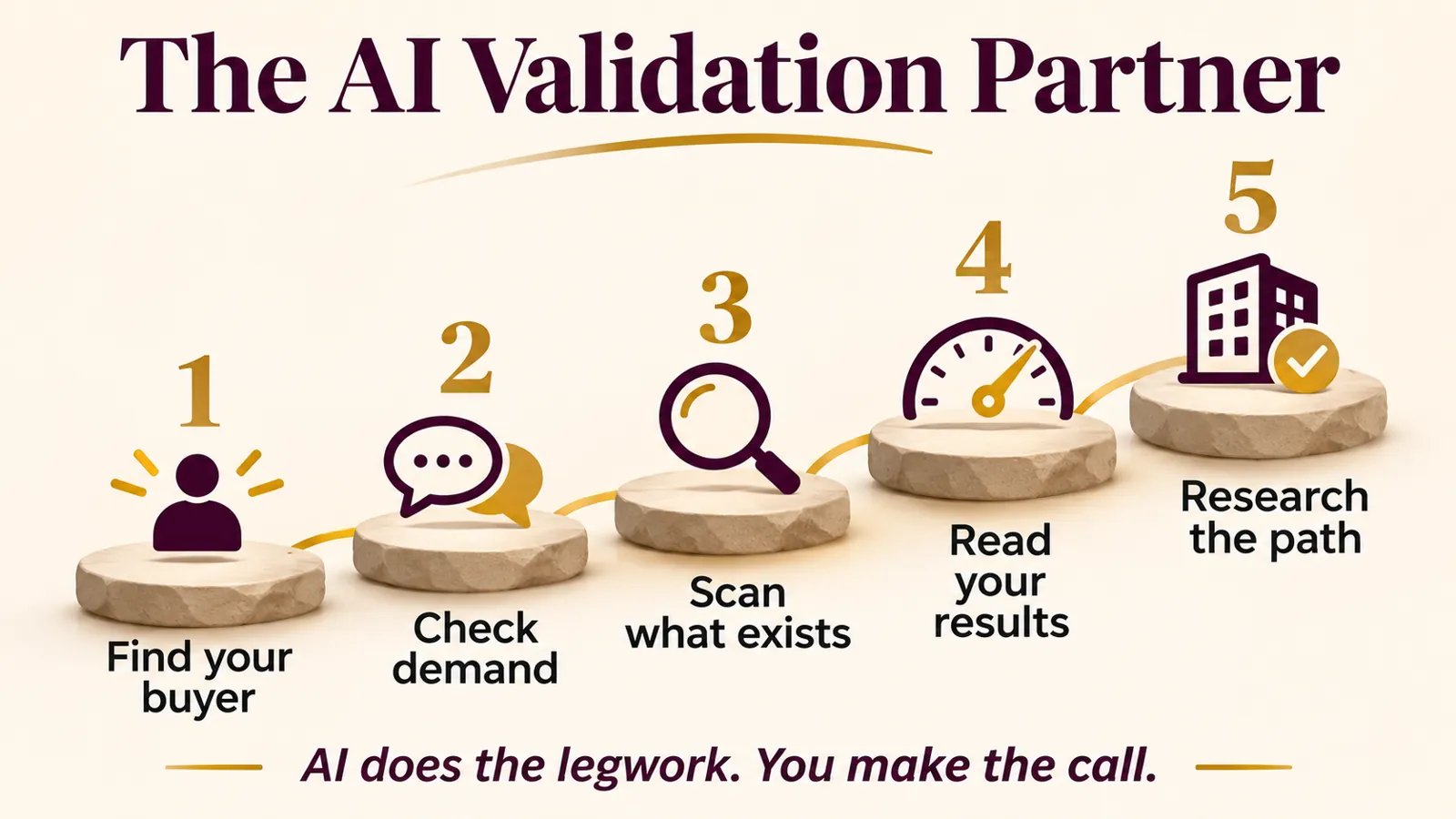
The AI Validation Partner is a five-job framework for using AI to validate new product ideas and inventions before you invest. AI finds your buyer, checks demand, scans what already exists, reads your validation results, and researches the right companies. You make every decision. AI does the first-pass legwork that used to take weeks or paid help.
Each job maps to a week in this series:
● Job 1. Find your buyer: name who actually pays (Week 3)
● Job 2. Check demand: separate real signal from polite interest (Week 4)
● Job 3. Scan what exists: run a first-pass search for similar products and patents (Week 8)
● Job 4. Read your results: turn a validation score into a next move (Week 9)
● Job 5. Research the path: shortlist licensing companies and manufacturers that fit (Week 11)
How does AI save inventors time and money?
AI saves inventors time and money by handling the first pass of research. It can sort hundreds of reviews, summarize competing products, draft patent search terms, and build a list of companies in your category. Work that once took weeks can start in an afternoon. You still verify every result before you spend.
Where the savings show up:
● Time: hours instead of weeks for first-pass research
● Money: fewer paid services before you know the idea is worth it
● Focus: you spend on the next step the evidence points to, not every step at once
The one rule that keeps AI honest
Ask AI to find problems, not to praise your idea.
AI tends to agree with the way you frame a question. “Is my idea good?” usually gets a yes. “Why would a buyer say no?” gets you something useful. Every prompt below is written to surface problems first.
16 AI Prompts to Validate Your Invention Before You Invest
Copy each prompt into ChatGPT, Claude, or the AI tool you use. Replace the brackets with your details. Run them in order, one job at a time. Save the answers in one document so your evidence builds as you go.
Job 1: How do I use AI to find my real buyer?
AI helps you find your real buyer by listing the groups most likely to pay and comparing them. You ask it who has the problem, where they shop, and what they use today. Then you pick one group to test first. “Everyone” is not a buyer. One named group is.
Prompt 1: Find your buyer groups
I invented [describe your product in one sentence]. List the three most likely buyer groups. For each, describe who they are, where they shop, what they use today instead, and what would make them switch. Then tell me which group is the strongest first buyer and why.
Prompt 2: Write your buyer pain statement
My product is [describe it] and my first buyer is [buyer group]. Write two versions of a buyer pain statement. Version one is frustration-based: “[Buyer] experiences [frustration] and needs [outcome] without [current workaround].” Version two is desire-based: “[Buyer] wants [feeling or experience] and currently settles for [lesser alternative].” Tell me which version fits my product better and why.
Job 2: How do I check real demand with AI?
You check real demand by looking at what buyers do and complain about, not what they say to be polite. AI can group hundreds of reviews into themes, draft interview questions that ask for commitment, and sort your notes into real signals and polite noise. That is the point of AI for market demand checks: behavior beats compliments every time.
Prompt 3: Mine the reviews
Here are 15 to 20 customer reviews of products similar to mine: [paste reviews]. Group the complaints into themes. Rank the themes by how often they appear. Tell me which complaints my product solves, which it does not, and which complaint is the strongest reason someone would switch.
Prompt 4: Write Cost Question interview questions
I’m interviewing [buyer group] about [problem]. Write 8 interview questions using the Cost Question approach. Don’t ask what they think of my idea. Ask what they currently spend in money, time, or effort on this problem, and what they would give up to fix it. Avoid questions that invite a polite yes.
Prompt 5: Separate signal from politeness
Here are my notes from buyer conversations: [paste notes]. Sort every statement into three groups: real commitment (they spent, signed up, or asked to buy), useful information (a specific problem or habit), and polite interest (compliments or “I’d buy that”). Tell me what the real commitments say about demand.
Job 3: How do I use AI to scan what already exists?
AI speeds up a first-pass search by suggesting the words other people use for your idea. It drafts search phrases for patent databases and stores, then helps you compare what you find. It does not replace a professional patent search. It helps you arrive prepared.
Prompt 6: Build your search phrases
My invention is [describe it]. Give me 10 search phrases to use on Google Patents, the USPTO Patent Public Search tool, and Amazon. Include other words people might use for the same idea, including industry terms and everyday words.
Prompt 7: Compare what you found
Here is my product: [describe it]. Here is a similar product or patent I found: [paste the description or abstract]. Make a two-column table of how they are the same and how they differ. List the questions I should bring to a registered patent attorney or patent agent. Do not give me a legal conclusion.
Prompt 8: Play the skeptical buyer
Act as a skeptical buyer in [buyer group] who already uses [current solution]. Give me the five strongest reasons you would not buy [my product]. Be direct. Then tell me which reason would be hardest for me to overcome.
Job 4: What do I do with my validation results?
A validation result is a next step, not a verdict. A low score tells you what evidence is missing. A mixed score tells you where to focus. A strong score tells you it may be time to prepare a pitch. AI can turn each weak area into a specific two-week action.
Prompt 9: Turn weak areas into actions
I scored [low, mixed, or strong] on an invention validation check. My weakest areas were [list them]. Explain what each weak area means in plain language. Then give me one specific action for each that would improve my evidence within two weeks.
Prompt 10: Make the call
Here is the evidence I have so far: [paste your buyer, demand, and search notes]. Help me write a one-page decision memo. List what is proven, what is still unproven, and the risks. Then lay out the case for three options: move forward, change the idea, or pause. Do not choose for me.
Job 5: How do I use AI to research licensing companies and manufacturers?
AI builds a starting list of companies whose product lines your idea fits, then helps you check each one. You still verify every company name, website, and submission policy yourself. This is AI for licensing due diligence. Ten well-matched companies beat a hundred random emails.
Prompt 11: Shortlist the companies
My product is [describe it], sold in [category] to [buyer group]. List 10 companies whose current product lines it could extend. For each, explain why it fits and what product of theirs it sits next to. Flag any company you are unsure exists so I can verify it.
Prompt 12: Check the fit
I’m considering pitching [company name]. Based on what I paste here from their website: [paste product line and about page], tell me how my product fits their line, which customers it helps them reach, and what questions I should answer before I contact them. Remind me to check whether they accept outside product ideas.
Prompt 13: Speak to the right role
I’m pitching [product] to [company]. Write a three-sentence opening for each of these roles: product manager, buyer, and head of new business. Show each person why this product makes them look like a smart find inside their company. Keep it plain and specific.
I Already Have a Patent. Do I Still Need to Validate?
Yes. A patent protects an invention. It does not prove anyone wants to buy it. Companies license business cases, not paperwork. If you hold a patent, validation shows a company who buys the product, why they buy it, and how it fits their line. That is what turns a patent into a conversation.
Patent holders often skip straight to Job 5. Start with Jobs 1 and 2 instead. A company will ask about the buyer before it asks about the claims.
Prompt 14: Build the business case for your patent
I hold a patent for [describe the invention in plain language]. Help me build a one-page business case a licensing company would want to read. Include the likely buyer, the problem it solves, what buyers use today, why a company in [category] would want it, and the three questions a company is most likely to ask me. Point out any gaps in my evidence.
I Haven’t Filed a Patent Yet. Where Do I Start?
Start with validation before you spend on filing. Run Jobs 1 through 3 first, so you know who buys, whether they care, and what already exists. Then talk with a registered patent attorney or patent agent before you share your idea publicly. Your options depend on your invention and your situation.
Prompt 15: Prepare for your attorney meeting
I’m meeting a patent attorney about [describe my invention]. Here is what I found in my search: [paste notes]. Write a list of plain-language questions I should ask, and a short summary of my invention and the similar products I found. Do not give me legal advice. Help me use the meeting time well.
Your Buyer Pain Statement
Every pitch starts with one clear sentence about the buyer. Use the version that fits your invention.
Frustration-based, for inventions that solve a problem:
“[Buyer] experiences [frustration] and needs [outcome] without [current workaround].”
Desire-based, for inventions that add delight or novelty:
“[Buyer] wants [feeling or experience] and currently settles for [lesser alternative].”
Not every invention fixes a frustration. If yours makes life more fun, more beautiful, or more personal, the desire-based version will describe it better.
One Prompt to Run All Five Jobs
Short on time? Use this to get a first pass across the whole framework. Then go back and run the individual prompts for the jobs that come back weak.
Prompt 16: The AI Validation Partner, all in one
Act as my AI Validation Partner. My invention is [describe it in two sentences]. Work through these five jobs in order and keep each section short. 1. Find my buyer: name the strongest first buyer group and why. 2. Check demand: list the signs that would prove real demand and the signs that would only show polite interest. 3. Scan what exists: give me 10 search phrases for patents and products. 4. Read my evidence: list what is proven and what is unproven based on what I’ve told you. 5. Research the path: list the types of companies whose product lines this could fit. Find problems first. Do not praise the idea. Do not give legal conclusions.
Is AI Validation Enough to Get a Licensing Deal?
No. AI validation gives you a strong starting point, but it doesn’t replace real buyer conversations, a careful search, or professional advice on patents and contracts. Think of AI as the partner who drafts the first version of your homework. Your judgment, your buyers, and qualified professionals finish it.
AI can be wrong. It can sound confident about a company that doesn’t exist or a patent it misread.
So check it. Click the sources. Read the patents. Talk to the buyer.
If you want a structured starting point, take the free Validation Assessment at https://www.inventmentors.com/validation. It’s 15 questions, takes about five minutes, and your results come back instantly. Then use Prompt 9 to turn those results into your next move.
Key Takeaways
● AI for inventors works best as a partner: it does the legwork, and you make every decision.
● The AI Validation Partner gives AI five jobs: find your buyer, check demand, scan what exists, read your results, and research the path.
● AI for product validation saves time and money on first-pass research, but you verify every answer before you spend.
● AI for market demand checks and AI for licensing due diligence turn weeks of first-pass research into a draft you can verify in an afternoon.
● A patent protects an invention. It does not prove demand. Patent holders still need a business case.
● Last week covered using AI to research licensing companies. This week puts that research inside one framework you run before you pitch.
Frequently Asked Questions
How can AI help me validate my invention idea?
AI can help you name your buyer, group customer complaints from reviews, draft interview questions, build patent and product search terms, and shortlist companies that fit. It speeds up first-pass research. It does not replace real buyer conversations or professional advice.
Which AI tool should inventors use?
Any major AI assistant, such as ChatGPT or Claude, can run the prompts in this article. The prompt matters more than the tool. Ask for problems, give specific details, and verify what comes back.
How do I license my product idea?
Start by validating it. Define your buyer, confirm demand, check what already exists, and shortlist companies whose product lines fit. Then approach those companies with a short pitch built around evidence.
Can I license an idea without a patent?
Sometimes. Some companies review unpatented ideas under their own submission terms. Others require a patent or a pending application first. Your options depend on your invention and the company. Talk with a registered patent attorney or patent agent before you share your idea.
Can AI tell me if my invention is patentable?
No. AI can help you search and organize what you find, but no AI tool can determine patentability. The USPTO makes that determination through examination. A registered patent attorney or patent agent can advise you on your specific situation.
What is the difference between licensing and selling a patent?
Licensing lets a company use your patent while you keep ownership, usually in exchange for royalties. Selling, also called assignment, transfers ownership to the buyer. Contract terms vary, so have an attorney review any agreement.
Next Steps
This is the last week of the AI for Inventors series. Here’s where to go from here:
● Missed a job? Go back to Week 3 for your buyer, Week 4 for the Cost Question, Week 8 for patent search, Week 9 for reading your results, and Week 11 for company research.
● Want a starting score? Take the free Validation Assessment at https://www.inventmentors.com/validation.
● Coming next: Licensing and Manufacturing Are Not the Same Business. It covers how to tell which path fits your invention before you commit.
Twelve weeks ago, your idea was a hunch.
Now you have a way to turn it into evidence.
Validate before you invest.
About the author: Suzi Murphy is the founder of Invent Mentors, a market validation and licensing strategy firm for inventors, founders, and patent attorneys. She has taken a product through the full licensing journey to a signed agreement with a brand manufacturer.
This article is for educational purposes only and is not legal advice. Invent Mentors does not provide legal advice or patent filing services. Every patent and licensing decision depends on your specific invention and situation. Talk with a registered patent attorney or patent agent before making a filing or disclosure decision.
Related reading
Ready for a structured score?
Take the free Validation Assessment. 15 questions, 5 minutes, instant clarity.
Get Your Validation Assessment (Free)