AI for Inventors · September 28, 2026
What Does Your Invention Validation Score Mean?
By Suzi Murphy, InventMentors
Your Validation Assessment score is not the finish line. It’s a signal. A low score doesn’t mean give up. A strong score doesn’t mean you’re ready to pitch tomorrow. This article breaks down what a low, mixed, or strong result actually means, and the one specific move to make for each.
Haven’t taken the Validation Assessment yet? Start there. It’s free, takes about five minutes, and gives you instant results at inventmentors.com/validation.
Don’t want to take it right now? The logic below still works. Sort whatever signal you already have, a buyer’s reaction, a pitch that went nowhere, feedback from someone in the industry, into low, mixed, or strong, and use the Next Move Map the same way.
What does my Validation Assessment score actually tell me?
Your score tells you where your idea currently stands on demand, buyer signal, and differentiation, based on the answers you gave. It doesn’t tell you to stop or go. It points you toward one specific next action, and that action is different depending on where you landed.
What should I do if I got a low score?
A low score is a pause signal, not a stop sign. Before you assume the idea is dead, research what buyers already dislike about existing options in this space. A low score usually means something about the demand or the buyer definition needs work, not that the invention itself is worthless.
What should I do if I got a mixed score?
A mixed score is the most common result, and the most confusing one to act on. Something about your idea validated. Something didn’t. Instead of reacting to the whole score, isolate the specific weak piece, demand, buyer, or differentiation, and fix that piece before touching anything else. Don’t rework the entire idea over one weak area.
What should I do if I got a strong score?
A strong score is a green light, not a guarantee. It means your foundation is solid enough to move toward the next stage: protecting your idea and preparing to pitch. Strong doesn’t mean you skip due diligence. It means you’ve earned the right to move forward carefully instead of blindly.
A real inventor’s result
An inventor came to me convinced a low score meant he had a bad idea. He was ready to walk away from it entirely.
He’d read the score as a verdict, not as a signal. What it was actually telling him was that he had homework left to do, before he spent more time and money on the wrong things.
Once he saw it that way, the low score stopped feeling like a stop sign. It became a list, a specific list of what to fix before trying again. He didn’t abandon the idea. He got clear on exactly what would take it from a low score to a high one.
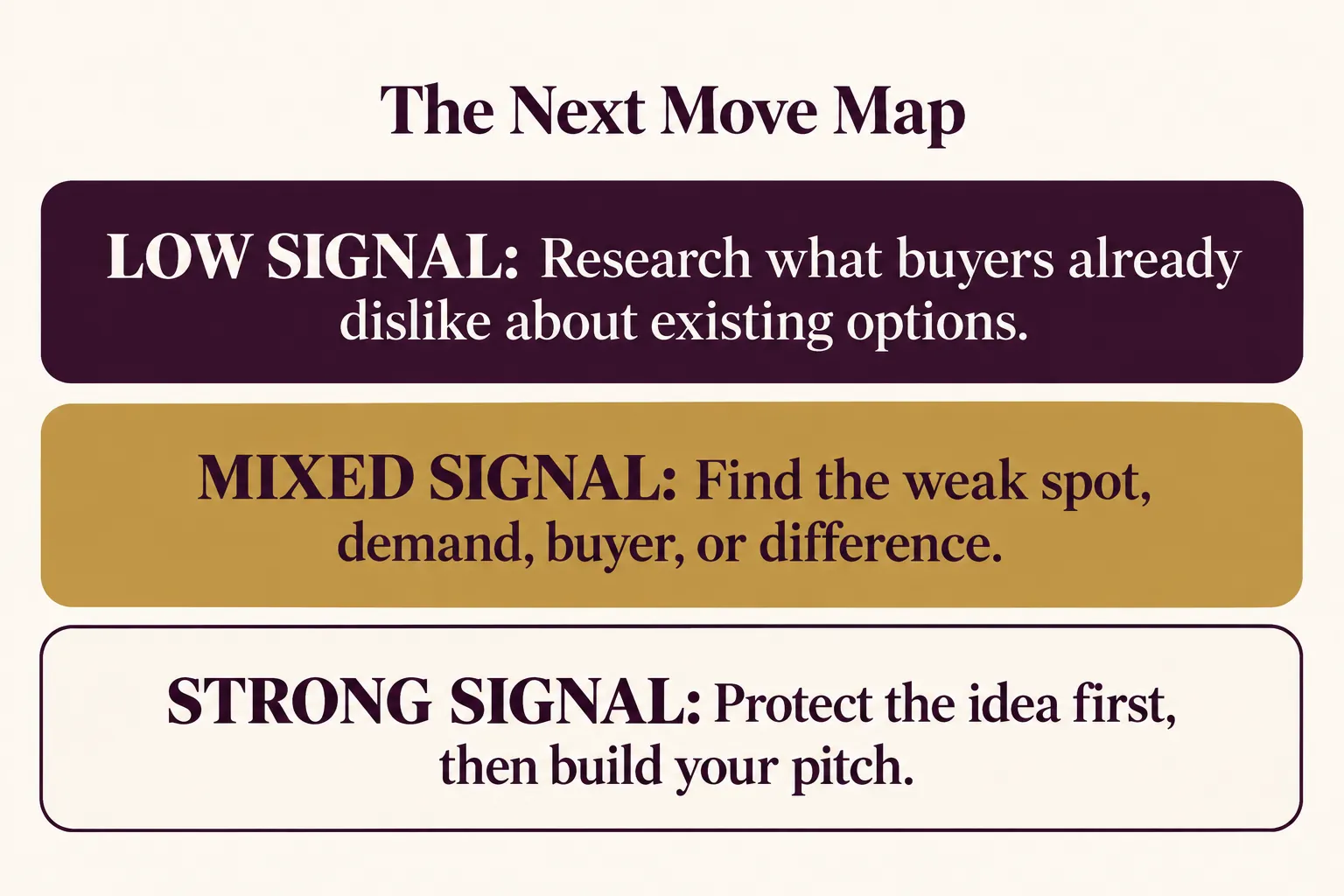
The Next Move Map
This works whether your result came from the official Validation Assessment or from a real-world signal you already have. Use it as a simple copy-paste reference:
● Low score. Pause, don’t stop. Research what buyers already dislike about existing options.
● Mixed score. Find the weak spot, demand, buyer, or difference, and fix that piece specifically.
● Strong score. Protect the idea first, then build your pitch.
Buyer pain, two ways
Frustration-based: Inventors experience anxiety and confusion after getting their Validation Assessment score. They need a clear next action for their specific result, without guessing what the number is supposed to mean.
Desire-based: Inventors want their next step to feel obvious once they have clarity on their idea. They currently settle for staring at a score with no idea what to do with it.
Four AI prompts to work through your result
Use these in order.
“I got a [low / mixed / strong] result on [my product validation assessment / a buyer conversation / a pitch that went nowhere / feedback from someone in the industry] for [describe your invention in one or two sentences]. Help me list what a result at this level usually signals about demand, buyer fit, and differentiation.”
“Based on that, what specific question should I go back and ask a potential buyer to get more clarity before I make any changes to the idea itself?”
“If my weak area turns out to be differentiation rather than demand, what does that usually mean, and how is fixing a differentiation problem different from fixing a demand problem?”
“Given my result, what’s the single next action I should take this week, not next month, to move this idea forward responsibly?”
Key takeaways
● A Validation Assessment score is a signal, not a finish line.
● A low score is a pause signal, not a stop sign, research what buyers already dislike about existing options.
● A mixed score is the most common result, isolate the one weak piece instead of reworking everything.
● A strong score is a green light, not a guarantee, protect the idea first, then build your pitch.
● Last week covered checking whether your idea has already been invented. This week picks up after that clarity step, once you have a score, here’s what it’s actually telling you to do.
Frequently asked questions
I got a mixed score. Does that mean my idea is average?
Not necessarily. A mixed score usually means one specific area needs attention while the rest of your idea is solid. It’s a diagnostic, not a grade.
Can my score change if I retake the assessment later?
Yes, especially after you’ve addressed the specific weak area the first result pointed to. The assessment reflects where your idea stands right now, not a permanent rating.
I got a strong score. Do I need to do anything else before pitching?
Yes. A strong score means your foundation is solid, not that your pitch materials, protection strategy, or company research are ready. Those are separate steps.
What if I don’t understand what my specific result means?
That’s normal, especially with a mixed result. Reach out directly and walk through the specifics of your score rather than guessing at what it means.
Next steps
Before you close this: write down two things. Your result, low, mixed, or strong, whatever signal you’re working from. And your one move from the map above. That’s it. You now have a next step instead of a score, or a feeling, sitting unused.
If you haven’t taken the Validation Assessment yet, this is the moment to start. Free, about five minutes, instant results, at inventmentors.com/validation.
A score is a signal. Read it like one.
Related reading
Ready for a structured score?
Take the free Validation Assessment. 15 questions, 5 minutes, instant clarity.
Get Your Validation Assessment (Free)